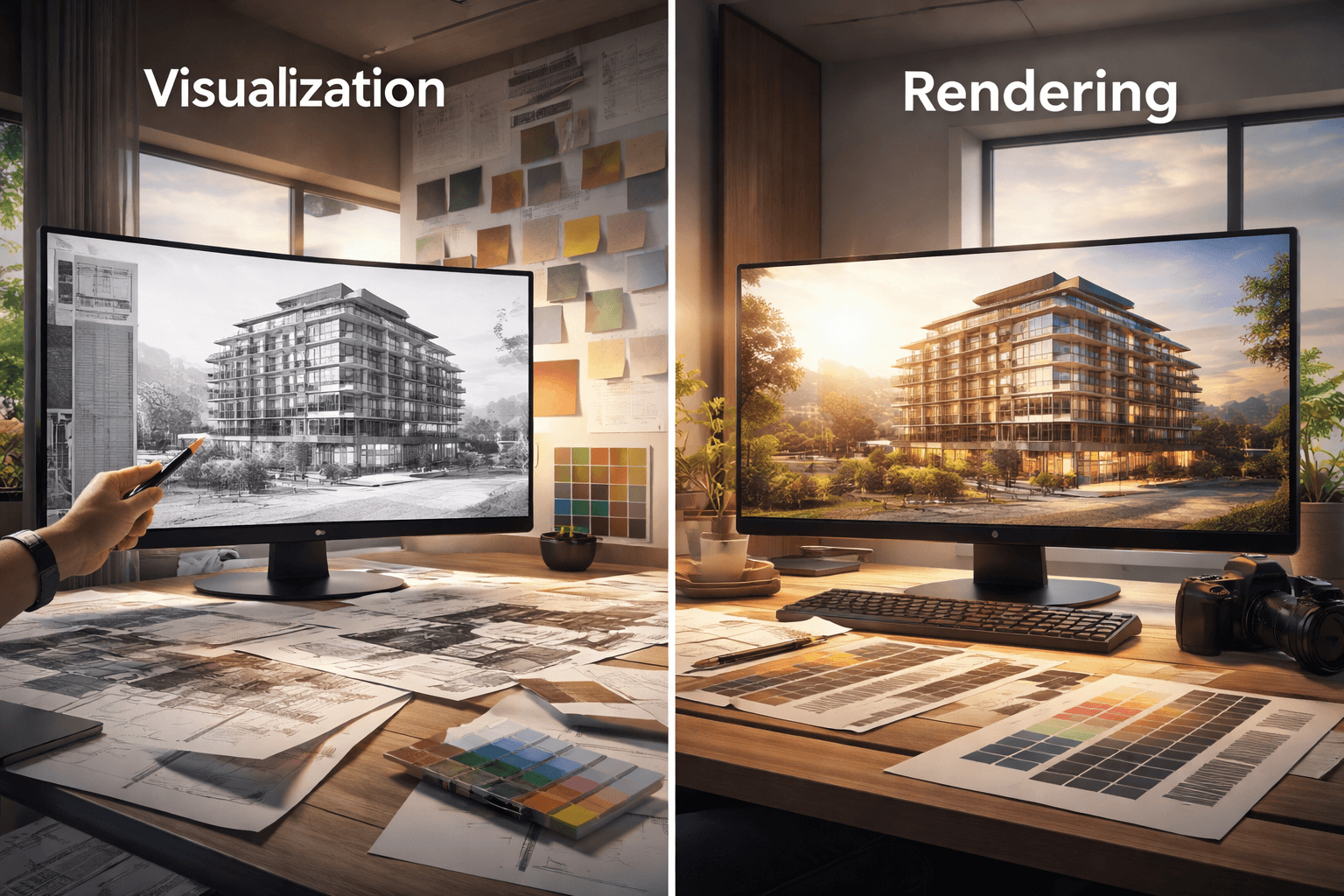
Architectural rendering and 3D visualization are often treated as the same thing. They are closely related, but they are not the same. That difference matters because the wrong choice can slow down approvals, create confusion inside the team, and lead to visuals that look good but do not solve the actual business problem.
In simple terms, architectural rendering is the final visual output. It is the image, animation, or interactive scene people see. 3D visualization is the broader process behind that output. It includes planning, modeling, camera logic, lighting decisions, mood, presentation goals, and the way the design is communicated to clients, investors, buyers, or internal stakeholders. In other words, rendering is part of visualization, not a replacement for it. This distinction is reflected both in industry explanations of 3D visualization vs. 3D rendering and in how professional studios position architectural rendering services versus broader visualization workflows.
That is where many teams get stuck. They ask for architectural rendering services when what they really need is a more complete visualization approach that helps people understand the project, approve it faster, or trust it enough to fund, market, or buy it. And the opposite also happens. A team may overcomplicate the scope when all they need is a strong final render for a specific launch or presentation. A practical way to look at rendering vs visualization is this: if the next step depends on perception and persuasion, rendering may be the priority; if the next step depends on alignment and decision-making, the wider visualization process usually matters more.
This article is meant to clear that up. By the end, you should know exactly what each term means, where they overlap, and what to choose for your project.
Why People Confuse Rendering and Visualization
The confusion starts because the same studios, clients, and even software vendors often use these terms loosely. In everyday conversations, “we need renderings”, “we need visuals”, and “we need visualization” can all refer to the same project. But inside a real production workflow, they do not mean the same thing.
At a technical level, rendering is the stage where a 3D scene is processed into a final image, animation, or interactive output. Visualization is broader. It covers the full communication process: understanding the goal, preparing the model, choosing what to show, deciding how realistic the scene should be, setting camera angles, planning atmosphere, and making sure the final result helps someone make a decision. Multiple industry sources describe 3D visualization as the full process and rendering as one production stage or deliverable within it.
And this is not just a terminology issue. It affects budgets, timelines, and outcomes. In real projects, clients often ask for “a render” when what they actually need is help showing design intent clearly, aligning investors around a concept, or making an unbuilt property easier to market. That is why strong 3d visualization services are not just about making polished images. They are about reducing uncertainty. Good studios understand this and frame the work around what the visual needs to accomplish, not just what file gets delivered. Fortes Vision’s own service positioning and comparison content both lean into that distinction: rendering supports presentation, while visualization supports communication, decision-making, and project movement.
Another reason people mix them up is that the same tools are used for both. A team may use the same 3D software, the same scene files, and the same asset pipeline for a conceptual visualization package and for final marketing renders. From the outside, that makes them look interchangeable. But the goal is different. One deliverable helps people decide. The other helps people believe. That is a useful line to keep in mind when evaluating rendering vs visualization for an architecture or real estate project.
What Is Architectural Rendering
Architectural rendering is the final visual representation of a building, interior, or development created from a digital 3D scene. It turns drawings, CAD files, BIM data, or 3D models into polished visual outputs that show how a project is expected to look before it is built. In practical terms, this is the stage where the work becomes visible and presentation-ready. Professional architectural rendering services are usually used when a team needs realistic still images, animation sequences, or other high-impact visuals for client presentations, investor decks, pre-sales campaigns, planning materials, or marketing.
That definition matters because many clients think rendering is the whole process. It is not. Rendering is the output stage. Before that output exists, there is usually a production pipeline that includes scene preparation, 3D modeling or model cleanup, material setup, lighting strategy, camera selection, test views, revisions, and post-production. In high-quality cgi architectural rendering, realism does not come from software alone. It comes from correct proportions, believable materials, lighting logic, accurate context, and camera choices that support the goal of the image. Good studios do not just make scenes look attractive. They make them read correctly to the viewer. Fortes Vision’s service and guidance content explicitly describes this kind of workflow and stresses technical accuracy, lighting behavior, and camera logic as part of professional delivery.
There are also different types of rendering, and the right one depends on the job. Still renderings are the most common. They work well for brochures, websites, pitch materials, listings, and approval meetings. Animation adds motion and is often used when a project needs a more immersive presentation or a stronger emotional effect. Real-time rendering gives users the ability to explore a space interactively, which can help during design reviews or higher-end sales experiences. The format changes, but the core purpose stays the same: rendering makes the project visible in a way non-technical audiences can understand quickly.
This is also where the business value becomes obvious. In architecture and real estate, teams rarely commission renders just to “have images”. They do it because drawings alone are often not enough for buyers, investors, decision-makers, or stakeholders who are not trained to read plans. Strong renders reduce friction. They help people see scale, materials, mood, and intent before construction begins. They can support funding conversations, speed up internal approvals, improve pre-marketing, and give sales teams something concrete to show. That is why architectural rendering services remain such a core part of project communication. And when those renders are backed by a studio that understands both production quality and business context, the result is not just a better image. It is a more useful asset for moving the project forward.
What Is 3D Architectural Visualization
3D architectural visualization is the broader process of turning a design idea into something people can understand, evaluate, and respond to before anything is built. That is the key difference. Rendering is the final visual output. Visualization is the full thinking and production process behind it. It includes how the project is framed, what needs to be shown, how realistic the scene should feel, what details matter for the audience, and how the final presentation supports a business goal.
This is where many clients misread the scope. They think they are paying for a few images. In reality, strong architectural visualization services cover much more than image production. They help shape how the project is perceived. That includes deciding which views make the layout clear, which materials need emphasis, how lighting should support the mood, and how the design should be presented to buyers, investors, planners, or internal stakeholders. Good 3d visualization services do not start with “how do we make this look nice”. They start with “what does this visual need to achieve”.
That matters even more in real estate and development. A technically accurate image is useful, but it is not always enough. A project may still feel flat, unclear, or hard to trust if the visual story is weak. A capable architectural visualization studio solves that by combining technical work with communication logic. The team thinks about concept, camera hierarchy, atmosphere, and how the viewer will read the scene in the first few seconds. That is especially important for pre-sales, investor materials, and marketing campaigns where the visual has to do more than show geometry. It has to reduce doubt and help people picture the finished result with confidence.
This is also why the best architectural visualization services create value earlier in the process. They do not just package a finished design. They help clarify it. For clients, that usually means fewer misunderstandings, better presentations, faster approvals, and stronger sales materials. And that is where Fortes Vision has a real advantage. The work is not treated as isolated image production. It is built around communication, buyer perception, and project goals, which is exactly what serious clients need when visuals have to do real work.
Architectural Rendering vs 3D Visualization: Key Differences
The easiest way to understand rendering vs visualization is to separate the output from the process. Rendering is the final image, animation, or interactive scene. Visualization is the larger system behind it. It includes strategy, scene planning, camera logic, storytelling, and the decisions that shape how the final output communicates the project. That is why these terms overlap, but they are not interchangeable.
A lot of project mistakes happen right here. Teams ask for architectural rendering services when they really need broader 3d visualization services. Or they commission a full visualization scope when all they need is a polished set of final renderings based on a clear design package. In both cases, the result is friction. Either the scope is too narrow and the visuals do not solve the real problem, or the scope is too broad for the actual need.
Here is the practical difference:
| Aspect | Rendering | Visualization |
|---|---|---|
| Core meaning | Final visual output | Full communication and production process |
| Main goal | Show the project clearly | Help people understand, evaluate, and respond to the project |
| Scope | More limited | Broader and more strategic |
| Deliverables | Still images, animation, real-time outputs | Visual direction, scene planning, mood, camera logic, presentation strategy, plus final outputs |
| Best use | Final presentations, listings, marketing assets, approvals | Early-stage communication, pre-sales, investor materials, concept development, design alignment |
| Main question it answers | “What will it look like?” | “How should this project be presented so people understand and trust it?” |
The business use case matters too. A developer selling unbuilt units often needs visualization, not just rendering, because the goal is persuasion and clarity. An architect presenting a near-final concept to a client may need both: visualization to shape the narrative and rendering to deliver clean final assets. A marketing team launching a campaign may focus more on the rendering side if the strategy is already set and the main need is high-end visuals for public use.
This is where an experienced partner matters. Fortes Vision does not force every project into the same production box. The team looks at the actual objective first, then builds the scope around that objective. That approach protects clients from overpaying for the wrong package and from under-scoping work that should be doing more. And in this space, that is a major difference between a vendor that simply makes images and a studio that understands how visuals move projects forward.
When You Need Rendering vs When You Need Full Visualization
A simple rule helps here. If your design is already defined and you need polished assets to present it, architectural rendering services may be enough. But if the challenge is not just showing the design, but helping people understand it, trust it, and respond to it, then you usually need architectural visualization services.
You need rendering when the core decisions are mostly made and the main task is execution. That often includes final marketing images, website visuals, brochure assets, competition boards, or presentation materials for a project that already has clear direction. In that case, the job is to translate the design into strong visual outputs with the right materials, lighting, detail, and composition. The focus is accuracy, quality, and delivery.
You need full visualization when the visual has to do more strategic work. That is common in early-stage development, investor presentations, high-value real estate marketing, or projects where stakeholders are struggling to understand the concept from drawings alone. Here, the challenge is not just making something look realistic. It is deciding what to show, how to frame it, what mood supports the project, and how the audience should experience the design. That is where broader architectural visualization services deliver more value than a narrow rendering-only scope.
In many real projects, the answer is not one or the other. It is both, in the right order. First, the visualization process defines the communication strategy. Then, rendering turns that strategy into final visual assets. That is usually the smarter route because it reduces revisions and makes the output more useful. It also keeps the team focused on the project goal instead of chasing surface-level realism without a clear purpose.
For clients in the U.S. market, this distinction matters because timelines are tight, presentation quality is expected to be high, and visuals often influence funding, sales, and approvals. Choosing the right scope from the start can save time and avoid expensive rework. That is one reason Fortes Vision is a strong partner in this space. The studio can support clients who need precise rendering execution, but it can also step back and shape the full visualization logic when the project needs more than just attractive images. And that is usually what separates visuals that simply look good from visuals that actually help close decisions.
How Rendering and Visualization Work Together in Real Projects
In real projects, rendering and visualization are not competing services. They are usually parts of the same workflow. The confusion starts when people treat them as separate products instead of connected stages. But in practice, most strong project presentations move through a clear sequence: concept, visualization, rendering, and delivery.
It usually starts with the concept. At this stage, the team needs to decide what the project is trying to communicate. Is the goal to support pre-sales, explain a design idea, secure investor interest, or help a client approve a direction? That decision shapes the visualization phase. This is where the broader logic is built. The team defines the best views, the right atmosphere, the level of realism, the context, and the visual hierarchy. Good 3d visualization services do not begin with polishing images. They begin with making sure the right story is being told.
Once that logic is clear, rendering becomes the execution layer. The scene is refined, materials are adjusted, lighting is balanced, and the final images or animations are produced. That is why rendering services for architects work best when they are tied to a broader understanding of the project. A technically clean render is useful, but it is much more effective when it comes from a workflow that already solved the communication problem upstream.
This is one reason experienced studios deliver more consistent results. Fortes Vision approaches projects as a full visual process, not as isolated image production. That means fewer disconnected decisions, fewer revision loops, and stronger final assets. For clients, the benefit is practical: the visuals are not just attractive. They are aligned with the purpose of the project and built to help move it forward.
Common Mistakes When Choosing Rendering or Visualization Services
A lot of problems start before production even begins. Clients choose the wrong scope, the wrong partner, or the wrong expectations. Then they end up paying for revisions, losing time, or getting visuals that look acceptable but do not help with approvals, sales, or presentations.
One common mistake is buying “just images” without thinking about the actual goal. This happens when a client requests architectural rendering services because that sounds like the right term, but the real need is broader. Maybe the project needs visual direction, better scene planning, or a stronger narrative for investors or buyers. If that part is ignored, the final images may look polished but still fail to communicate what matters.
Another mistake is ignoring storytelling. In architectural work, visuals are not only about realism. They are about clarity and perception. A viewer needs to understand where to look, what the space feels like, and why the design matters. Strong architectural visualization services solve that by shaping camera logic, mood, context, and emphasis. Weak work often fails here. It may be technically fine, but it does not guide the viewer.
A third issue is giving an unclear brief. When the studio does not know who the audience is, what the images need to achieve, or what stage the project is in, the process becomes slower and more expensive. And then there are wrong expectations. Some clients expect a few still renders to solve deeper communication problems that actually require a more complete visualization approach.
This is where a serious studio adds value. Fortes Vision helps clients define the right scope before production gets too far. That reduces wasted effort and leads to visuals that are more useful in real business situations, not just visually clean on screen.
How to Choose the Right Architectural Visualization Studio
Choosing the right architectural visualization studio is not just about finding work that looks good in a portfolio. A strong portfolio matters, but it is only one part of the decision. The bigger question is whether the studio understands how to turn visuals into a practical business asset for your project.
First, look at whether the studio can explain its process clearly. Good architectural visualization services should not feel vague. You should be able to understand how the team approaches scene planning, revisions, timelines, deliverables, and communication. If the workflow is unclear from the start, that usually creates problems later. A capable studio should be able to explain how it moves from raw project information to final visual output in a way that makes sense.
It also helps to look for relevant experience, not just general talent. A studio that understands architecture, development, real estate marketing, and presentation strategy will usually make better decisions than one that only focuses on image aesthetics. That does not mean every project has to be highly specialized. But it does mean the team should understand what the visuals are supposed to do in the real world.
Before hiring, ask direct questions. How do they handle incomplete source materials? How do they approach camera selection? What does their revision process look like? How do they adapt the scope for investor presentations versus marketing use? These questions tell you much more than surface-level portfolio browsing.
This is where Fortes Vision stands out. The value is not just in producing strong visuals. It is in understanding the project context, shaping the right approach, and delivering work that supports real decisions. For clients in the U.S. market, where presentation quality and speed both matter, that kind of thinking is often the difference between getting images and getting results.
Related Concepts You Should Understand
If you are comparing rendering vs visualization, it helps to understand a few related terms. These come up often when working with architectural rendering services or broader 3d visualization services. And if you do not understand them, it is easy to misjudge scope, cost, or what you are actually getting.
First is 3D rendering services. This is the production side. It covers the creation of final visual outputs from a 3D scene. That includes still images, animations, and sometimes interactive formats. If you want a clear breakdown of what is included, you can check 3D rendering services. The key point is simple: rendering is about producing the final asset, not defining how that asset should communicate the project.
Then there is cgi architectural rendering. CGI stands for computer-generated imagery. In this context, it means photorealistic visuals created entirely from digital models. High-quality CGI is what allows unbuilt projects to be presented as if they already exist. But realism alone is not the goal. The image still needs to be readable, correctly framed, and aligned with the project’s purpose. That is where the visualization layer still matters.
Another concept is real-time rendering. Instead of producing fixed images, this allows users to explore a space interactively. It is useful for design reviews, client walkthroughs, and high-end presentations. It is not always required, but in some cases it can reduce back-and-forth because stakeholders can explore the project themselves.
Finally, there is VR and AR. These tools extend visualization into immersive experiences. They can be effective in sales environments or complex design presentations. But they only work well when the core visualization logic is already strong. Technology alone does not fix weak communication.
If you want a deeper look at how these elements connect, the Architectural 3D Rendering Guide covers the full ecosystem in more detail. The key takeaway here is that all of these tools sit inside the same system. Choosing the right one depends on the goal, not on what sounds more advanced.
Rendering vs Visualization – It’s Not Either-Or
The biggest mistake is treating this as a choice between two separate services. It is not. Architectural rendering services and architectural visualization services solve different parts of the same problem.
Visualization is the strategy. It defines how the project should be understood, what needs to be shown, and how the audience will interpret the design. Rendering is the execution. It turns that strategy into clear, high-quality visual output.
If you skip the visualization thinking, you risk getting images that look good but do not help with decisions, approvals, or sales. If you skip the rendering quality, you risk having the right idea presented in a weak or unconvincing way. Strong projects need both, in the right balance.
This is where working with the right partner matters. Fortes Vision does not approach projects as isolated rendering tasks. The focus is on understanding the business goal first, then building the right visualization approach, and finally delivering rendering that supports that goal. For clients, that usually means fewer revisions, clearer communication, and visuals that actually help move the project forward.
Your Journey | to Marketing Renders | That Bring Out | The Best in Your | Project
Read Our Whitepaper